Friday, August 15, 2008
Golden Eagle Audubon visits IBO (8-9-08)
This last Saturday a contingent (19 strong) of GEAS came on a field trip to view the songbird migration banding at Lucky Peak. I was traveling back from the conference in Portland that day and was bumbed to miss some great folks but I gather that everyone enjoyed the visit and Gary Robinson was kind enough to get some photos for me. I always enjoy these trips because many good questions are always asked and it's nice to catch up with some great local birders. See you next time!
Here's Bruce (center) detailing something ;-) - maybe he's explaining how bird skulls ossify!
Heriberto (left) & Heidi probably discussing the finer points of Empidonax flycatcher identification as the crowd looks on.
Saturday, August 09, 2008
2008 Cooper Ornithological Society/ American Ornithologist's Union/Society of Canadian Ornithologist's meeting
I returned to Boise 1.5 hours ago from the 2008 joint conference of three ornithological societies (Cooper Ornithological Society, American Ornithologist's Union, and the Society of Canadian Ornithologists) that took place in Portland, OR. It was an exciting meeting with over 900 attendees .....
Many of the banquet attendees for the 2008 conference ... lots of bird-nerds!
There were many great presentations but one of the main highlights for me was that as I stood up to give my presentation (comparing stopover ecology and capture heights of birds between Lucky Peak & Camas NWR), I could see 6 former IBO field assistants in the crowd (& 2 others were also at the conference)! All cool people & it was rewarding to hear about their research, etc. I was able to catch 5 of them on film (unfortunately, I didn't come up with the photo idea until the final afternoon and several folks couldn't be found among the hordes of ornithologists):

Catalina LondoƱo and Gabriel Colorado (both from Colombia). Gabriel worked at Lucky Peak in 1999 and then both Cata and Gabriel were at Lucky Peak for a couple weeks in 2003. Gabriel is now studying Cerulean Warblers for his PhD at Ohio State University and Cata is about to begin a Fulbright scholarship supported PhD in Environmental Economics at Illinois (Champaign-Urbana).
Zoltan Nemeth (left, from Hungary) alongside some colleagues (Jen Owen, Emily Cohen, and Kristina Paxton) affiliated with the Migratory Bird Research Group at U of Southern Mississippi. Zoltan worked with us in the summer & fall of 2000 (and we hadn't seen each other since!). He's married & about to complete his PhD with Frank Moore studying social behavior of migrating birds. (Also, I worked for Jen 10 years ago on a spring migration study in Louisiana!!)
Khara Strum (left, sitting with Susan Skagen of USGS in Colorado) is from Ohio and just finished her Masters at Kansas State where she studied pesticide exposure for migrating and wintering shorebirds. Khara worked at IBO in 2003 & 2004.
Michelle Labbe and Scott Kimball. Michelle worked with me at Camas NWR in 2005 and is about to finish her Masters at UMass where she studies the post-breeding ecology of migratory birds. Scott is a former BSU raptor biology student who's about to finish his PhD at Ohio State.
Catalina LondoƱo and Gabriel Colorado (both from Colombia). Gabriel worked at Lucky Peak in 1999 and then both Cata and Gabriel were at Lucky Peak for a couple weeks in 2003. Gabriel is now studying Cerulean Warblers for his PhD at Ohio State University and Cata is about to begin a Fulbright scholarship supported PhD in Environmental Economics at Illinois (Champaign-Urbana).
Needless to say, it was a lot of fun to see all these folks (along with Dan Battaglia, Dale Gentry, and Jeremy Russell -not shown) and catch up!
Cheers,
Jay
Cheers,
Jay
Summer/Early Fall Banding Results (so far)
Greetings IBO blog-readers (anyone still out there after the loooong gap between posts??)
After a busy summer and some training of a new (& stellar) crew for our fall migration season, I'm aiming to get back on the ball and post at least somewhat regularly ....
We had a late start to the breeding season up at Lucky Peak - likely due to the cool weather in late May/early June that stalled all those Western Tanagers in the valley areas - and we've seen the impact during our breeding season banding (early June to early July). Normally we see fledglings by late June and the pulse of young birds didn't really begin until well into June. So far it appears that birds that arrived before the cool spring weather (such as Nashville Warblers) were able to breed "on time" whereas late arrivers such as Western Tanagers, Warbling Vireos, and MacGillivray's Warblers were delayed by up to a couple weeks in their breeding efforts. Thus, not sure if their delayed spring arrival will impact their reproductive success and/or their fall departure timing ....
Here's a shot of our large group of volunteers that came up for our June 26 summer banding day, including (from back left): Kathl, Gary, Ruth (visiting from UT), Jody, Mike (visiting from Portland), Heidi, & (front row, from left) Dave, Greg, Deniz, Ayla, Carol, & Sylvia.
Our fall migration season began on July 16th and we've had a great start so far. Not as busy bird-wise as the last 2 seasons (likely due to the reproduction delays mentioned above) but we once again have a great crew (see below; Marissa just arrived a few days ago so we'll get a new team shot soon ...). We've already enjoyed several visitors (including Golden Eagle Audubon Society today) and we're looking forward to more!

Early-season team shot: (from left) Heriberto, Kris, Gary, Jay, & Heidi
Heriberto is from Jalisco, Mexico (and has worked with many of the same species on the wintering grounds for many years), Kris is from southern California (and is a long-time birder & Audubon member), Gary (Mountain Home) is in his 5th year of volunteering on our project, and Heidi is an undergrad at Boise State U. who's been hooked on birds for years already.
Katie Babcock & campers from the Tumble Time program during a June 17 field trip.
After a busy summer and some training of a new (& stellar) crew for our fall migration season, I'm aiming to get back on the ball and post at least somewhat regularly ....
We had a late start to the breeding season up at Lucky Peak - likely due to the cool weather in late May/early June that stalled all those Western Tanagers in the valley areas - and we've seen the impact during our breeding season banding (early June to early July). Normally we see fledglings by late June and the pulse of young birds didn't really begin until well into June. So far it appears that birds that arrived before the cool spring weather (such as Nashville Warblers) were able to breed "on time" whereas late arrivers such as Western Tanagers, Warbling Vireos, and MacGillivray's Warblers were delayed by up to a couple weeks in their breeding efforts. Thus, not sure if their delayed spring arrival will impact their reproductive success and/or their fall departure timing ....
Our fall migration season began on July 16th and we've had a great start so far. Not as busy bird-wise as the last 2 seasons (likely due to the reproduction delays mentioned above) but we once again have a great crew (see below; Marissa just arrived a few days ago so we'll get a new team shot soon ...). We've already enjoyed several visitors (including Golden Eagle Audubon Society today) and we're looking forward to more!
Early-season team shot: (from left) Heriberto, Kris, Gary, Jay, & Heidi
Heriberto is from Jalisco, Mexico (and has worked with many of the same species on the wintering grounds for many years), Kris is from southern California (and is a long-time birder & Audubon member), Gary (Mountain Home) is in his 5th year of volunteering on our project, and Heidi is an undergrad at Boise State U. who's been hooked on birds for years already.
Monday, November 26, 2007
recovery information for a Willow Flycatcher(!!)
Hi Folks
We just received news that a Willow Flycatcher (band # 2460-68120; pictured below aside a Hammond's Flycatcher) that we captured on August 9, 2007 at our Lucky Peak fall migration station was originally banded by a colleague with the Utah DNR on August 25, 2006 in Hailstone, UT!! At least 250 miles as the crow flies ....
The bird is a 1-year-old female (hatched in 2006) - based on molt limits (not having replaced all feathers in the wing - a characteristic of many 1-year-old birds) and a brood patch.
Interestingly, Willow Flycatchers don't breed at Lucky Peak, we only catch an average of about 2 per year, and this bird was our only Willow of the fall 2007 season. Meanwhile, we caught about 250 Willows in a couple years at Camas NWR (more directly N of Utah) with no foreign encounters ....
As much as I was hoping to get a breeding location on this bird, it's pretty cool info to know it was migrating through Utah in 2006 and southwestern Idaho in 2007. And, the timing of each capture makes sense based on molt strategy because adults migrate earlier than immatures in this species.

Willow Flycatcher (right side in both photos) captured at Lucky Peak on Aug 9, 2007. This bird was originally banded as an immature bird on August 25, 2006 in Hailstone, Utah... For those Empidonax fanatics out there, that's a Hammond's Flycatcher on the left; notice the differences in bill size (bigger/wider on Willow), plumage color (greener upperparts on Hammond's vs. browner upperparts and a white throat on the Willow), and the lack of eye-ring on the Willow.
We just received news that a Willow Flycatcher (band # 2460-68120; pictured below aside a Hammond's Flycatcher) that we captured on August 9, 2007 at our Lucky Peak fall migration station was originally banded by a colleague with the Utah DNR on August 25, 2006 in Hailstone, UT!! At least 250 miles as the crow flies ....
The bird is a 1-year-old female (hatched in 2006) - based on molt limits (not having replaced all feathers in the wing - a characteristic of many 1-year-old birds) and a brood patch.
Interestingly, Willow Flycatchers don't breed at Lucky Peak, we only catch an average of about 2 per year, and this bird was our only Willow of the fall 2007 season. Meanwhile, we caught about 250 Willows in a couple years at Camas NWR (more directly N of Utah) with no foreign encounters ....
As much as I was hoping to get a breeding location on this bird, it's pretty cool info to know it was migrating through Utah in 2006 and southwestern Idaho in 2007. And, the timing of each capture makes sense based on molt strategy because adults migrate earlier than immatures in this species.
Willow Flycatcher (right side in both photos) captured at Lucky Peak on Aug 9, 2007. This bird was originally banded as an immature bird on August 25, 2006 in Hailstone, Utah... For those Empidonax fanatics out there, that's a Hammond's Flycatcher on the left; notice the differences in bill size (bigger/wider on Willow), plumage color (greener upperparts on Hammond's vs. browner upperparts and a white throat on the Willow), and the lack of eye-ring on the Willow.
Sunday, November 25, 2007
New website
IBO has a brand spankin' new website. We are really excited with the new look. Many thanks to Holly Funk who donated her time and creative expertise in designing a beautiful website.
Please visit: www.idahobirdobservatory.org
Friday, November 02, 2007
Final Raptor Numbers at Lucky Peak
On Wed, Oct 31 the hawk counters (Chadi & Kyle) sat on the hill counting southbound raptors for the last time in 2007 - thus bringing to a close the fall 2007 migration monitoring season. I should note that some raptors, including Northern Goshawks (the counters mentioned seeing several adults on the move during the last few days), are certainly continuing to migrate through... It's just that the #s dwindle after October and it's important to stick to standardized dates for our monitoring to mean anything.
OK, enough babbling ... on to the #s for diurnal raptors and owls.
Diurnal Raptor season totals, 25 Aug to 31 Oct, 2007 (in descending order of abundance):
Turkey Vulture 1189
Red-tailed Hawk 1059
Sharp-shinned Hawk 947
American Kestrel 581
Cooper's Hawk 494
Northern Harrier 135
Northern Goshawk 76 (2nd best year ever; well over annual average of 43)
Osprey 55
Swainson's Hawk 41
Golden Eagle 35
Merlin 28
Broad-winged Hawk 20
Peregrine Falcon 12
Rough-legged Hawk 7
Ferruginous Hawk 4
Bald Eagle 3
Prairie Falcon 1
Red-shouldered Hawk 1
...for a total of 4,814 counted (for those doing the math, this includes several categories of unidentified raptors that observers couldn't be absolutely certain about due to poor views). This is lower than average but is up 300 birds from last year (which was the lowest since 1995). Of the 5 most common species, RT Hawks and vultures #s in 2007 are above average whereas the other 3 (Sharp-shins, Cooper's, and kestrels) are all below average. In particular, American Kestrel #s are just over 1/2 of average and 2006 & 2007 have been the 2 lowest years since the study began in the mid-1990s.
Maxi Galmes (Argentina) holding an (unhappy) immature Northern Goshawk. 2007 was one of our best years for this charismatic raptor species.
OK, enough babbling ... on to the #s for diurnal raptors and owls.
Diurnal Raptor season totals, 25 Aug to 31 Oct, 2007 (in descending order of abundance):
Turkey Vulture 1189
Red-tailed Hawk 1059
Sharp-shinned Hawk 947
American Kestrel 581
Cooper's Hawk 494
Northern Harrier 135
Northern Goshawk 76 (2nd best year ever; well over annual average of 43)
Osprey 55
Swainson's Hawk 41
Golden Eagle 35
Merlin 28
Broad-winged Hawk 20
Peregrine Falcon 12
Rough-legged Hawk 7
Ferruginous Hawk 4
Bald Eagle 3
Prairie Falcon 1
Red-shouldered Hawk 1
...for a total of 4,814 counted (for those doing the math, this includes several categories of unidentified raptors that observers couldn't be absolutely certain about due to poor views). This is lower than average but is up 300 birds from last year (which was the lowest since 1995). Of the 5 most common species, RT Hawks and vultures #s in 2007 are above average whereas the other 3 (Sharp-shins, Cooper's, and kestrels) are all below average. In particular, American Kestrel #s are just over 1/2 of average and 2006 & 2007 have been the 2 lowest years since the study began in the mid-1990s.
Now, for the owl totals (28 Aug to 28 Oct):
Northern Saw-whet Owl 120
Flammulated Owl 6
Though the #s seem less impressive than for the raptors (especially for the Flammulated), this was the best overall owl season since 2003. And, the Saw-whets likely generate the most fascination and awe on a 'per-bird' basis- as all visitors who've enjoyed seeing these guys up close know.
Lastly, the top ten songbird species (that I neglected to post last time):
Dark-eyed Junco 1111 (a new record)
Ruby-crowned Kinglet 788 (2nd lowest year)
White-crowned Sparrow 403
Dusky Flycatcher 356
Yellow Warbler 290 (a new record)
MacGillivray's Warbler 285
Yellow-rumped Warbler 284
Spotted Towhee 238
Warbling Vireo 216 (a new record)
Western Tanager 201
Cheers,
Jay
Northern Saw-whet Owl 120
Flammulated Owl 6
Though the #s seem less impressive than for the raptors (especially for the Flammulated), this was the best overall owl season since 2003. And, the Saw-whets likely generate the most fascination and awe on a 'per-bird' basis- as all visitors who've enjoyed seeing these guys up close know.
Lastly, the top ten songbird species (that I neglected to post last time):
Dark-eyed Junco 1111 (a new record)
Ruby-crowned Kinglet 788 (2nd lowest year)
White-crowned Sparrow 403
Dusky Flycatcher 356
Yellow Warbler 290 (a new record)
MacGillivray's Warbler 285
Yellow-rumped Warbler 284
Spotted Towhee 238
Warbling Vireo 216 (a new record)
Western Tanager 201
Cheers,
Jay
Monday, October 29, 2007
Final songbird #s from Lucky Peak
Hi Folks .... (scroll down for a few photos)
I was delayed in getting to this because a day after closing up shop (on Oct 15) I flew east for a high school buddy's wedding in the Catskills Mountains of NY (awesome fall colors! - 1st time in many years that I've gotten to see that) and a short family visit. Thus, I just got done counting & re-counting the #s. Here we go:
During autumn 2007 (16 July to Oct 15), we captured 5771 birds of 56 different species. Our netting effort this year was 4116 mist net hours; this effort is lower than usual because we experienced a number of rainy and/or windy days that either prevented us from netting or reduced the number of nets that could be opened. The 2007 capture rate of 1.40 birds per mist net hour (which comes to 70 birds on an average day on which we open all 10 nets for 5 hours) is the 2nd highest in the 11 years of the study (2nd to the record season of 2006, when the capture rate was an amazing 1.71). Thus, if anything we are seeing a slight increase in captures over the years for a number of species. And, this is reflected in the fact that 2007 set record years for 8 species (and several others were tied or close 2nd). The new records set in 2007 are (in numerical order):
Dark-eyed Junco 1111 (previous high of 918 in 2006)
Yellow Warbler 290 (previous high of 186 in 2001)
Warbling Vireo 216 (previous high of 193 in 2006)
Cassin's Vireo 117 (previous high of 114 in 1999)
Brewer's Sparrow 87 (previous high of 58 in 2000)
Swainson's Thrush 26 (previous high of 20 in 2006)
Northern Pygmy-owl 10 (previous high of 5 in 2000)
Steller's Jay 4 (previous high of 3 in 2001)
Interestingly, 2007 was the first year in which Ruby-crowned Kinglets (shown here) were not the most abundant species (we caught 788; 2nd to Dark-eyed Juncos this year) and only the 3rd time we've not banded at least 1000 of this species in a season. We lost so many days and partial days to weather during the RC Kinglet peak (mid-Sept into October) that this result isn't surprising. But, it really was a stellar year for the juncos ...
Rarities/highlights from this season included the 5th Blackpoll Warbler we've banded at this site (Sept 7), our first capture of a Black-throated Gray Warbler (Aug 19), our 5th American Redstart (Aug 22), our 4th ever Green-tailed Towhee, and 4 Golden-crowned Sparrows (Sep 17, 21 [2 birds] and Oct 7). Also, in early August we captured a Willow Flycatcher that was previously banded by someone else (don't know who or where yet...).
Enjoy the late fall/early winter birding!
Jay
Wednesday, October 10, 2007
10-10-07 update
Sorry Folks for the long delay!
Between the bad weather getting me down, a lovely stomach flu ;-), and the activity being generally busy on Lucky Peak, I haven't had time to post for a while. And now I find myself 5 days from the end of the songbird season (Carlos is flying home to Venezuela tomorrow!) ....
Many weather events have punctuated the last 2.5 weeks and have made the migration a little helter-skelter. In fact, the owl netting has been the most consistent aspect of the project lately as Northern Saw-whet Owl migration has picked up speed and multiple owls have been caught nightly for at least the last week. If only we could get a calm night, maybe we could catch more!
Hawks & songbirds have been more hit or miss as it seems we've either had rain or strong SE winds for much of the last couple weeks. However, on days without these downer types of weather, flights have been very strong as birds seem to be migrating in any window of decent weather. Thus, I expect any decent weather days in the coming week or 2 to be pretty good days to see loads of juncos as well as the possibility of a Northern Goshawk, Merlin, or maybe even a Rough-legged Hawk migrate past Lucky Peak.
Highlights from the last week include a possible Slate-colored Junco (maybe it was a hybrid but pretty close anyway) captured today and an adult 'Harlan's' Red-tailed Hawk caught by Eric Hallingstad on Saturday. We see Harlan's every year but rarely catch them - this may be the first adult we've ever banded! See pictures below.
Lastly, we finish the songbird season on Monday, October 15th; owls wrap up on Oct 28; and hawk counting continues thru the end of the month.
Cheers,
Jay
--------------------------------------------------
Below are 3 images of the adult Harlan's Hawk banded on October 6, 2007. Noted the white spots on the dark chest and the marbled tail:


The next 2 images are from a Dark-eyed Junco showing signs of being the Slate-colored subspecies. The photos didn't come out too well (terrible lighting today) but the first picture shows that the sides of the chest are grayish and lack the pink tones of Oregon or Pink-sided. However, the back (2nd image) shows more brownish than ideal for Slate-colored (especially for an adult, which this bird was). Thus, likely best left as an Unidentified Dark-eyed Junco subspecies.

Here is an adult male Oregon Junco for comparison - note the pink sides of the chest.
Between the bad weather getting me down, a lovely stomach flu ;-), and the activity being generally busy on Lucky Peak, I haven't had time to post for a while. And now I find myself 5 days from the end of the songbird season (Carlos is flying home to Venezuela tomorrow!) ....
Many weather events have punctuated the last 2.5 weeks and have made the migration a little helter-skelter. In fact, the owl netting has been the most consistent aspect of the project lately as Northern Saw-whet Owl migration has picked up speed and multiple owls have been caught nightly for at least the last week. If only we could get a calm night, maybe we could catch more!
Hawks & songbirds have been more hit or miss as it seems we've either had rain or strong SE winds for much of the last couple weeks. However, on days without these downer types of weather, flights have been very strong as birds seem to be migrating in any window of decent weather. Thus, I expect any decent weather days in the coming week or 2 to be pretty good days to see loads of juncos as well as the possibility of a Northern Goshawk, Merlin, or maybe even a Rough-legged Hawk migrate past Lucky Peak.
Highlights from the last week include a possible Slate-colored Junco (maybe it was a hybrid but pretty close anyway) captured today and an adult 'Harlan's' Red-tailed Hawk caught by Eric Hallingstad on Saturday. We see Harlan's every year but rarely catch them - this may be the first adult we've ever banded! See pictures below.
Lastly, we finish the songbird season on Monday, October 15th; owls wrap up on Oct 28; and hawk counting continues thru the end of the month.
Cheers,
Jay
--------------------------------------------------
Below are 3 images of the adult Harlan's Hawk banded on October 6, 2007. Noted the white spots on the dark chest and the marbled tail:
The next 2 images are from a Dark-eyed Junco showing signs of being the Slate-colored subspecies. The photos didn't come out too well (terrible lighting today) but the first picture shows that the sides of the chest are grayish and lack the pink tones of Oregon or Pink-sided. However, the back (2nd image) shows more brownish than ideal for Slate-colored (especially for an adult, which this bird was). Thus, likely best left as an Unidentified Dark-eyed Junco subspecies.


Here is an adult male Oregon Junco for comparison - note the pink sides of the chest.
Sunday, September 23, 2007
9-23 update
Hi Folks
Just a quick update. Friday (Sept 21) was a great migration day at Lucky Peak: the highest one-day totals for songbirds (165 banded) and raptors (522 counted) of the season. Probably this was a big movement in front of our recent rain event but this is also traditionally a peak time for abundance of migrants in this area.
10 Broad-winged Hawks were seen on Friday alone, bringing the season
total to 16. Sept 10-25 (especially the 20th-25th) are usually the
best dates for this species (with some continuing into early October) so I
expect more to pass by in the coming week as high pressure weather
resumes. Also, though far rarer (not annual), Red-shouldered Hawks
seem to appear most often in the last 10 days of September.
Songbirds are now dominated by RC Kinglets, WC Sparrows, and DE Juncos
and we are seeing an earlier than usual push for juncos (who seem to
have the most variable timing of all species we catch but often peak
in October). But, we are still seeing a some warblers, Cassin's
Vireos, Hammond's Flycatchers, & others in the mix. Pine Grosbeaks
were around for a few days late last week & I'm hoping for more ....
Happy birding,
Jay
Just a quick update. Friday (Sept 21) was a great migration day at Lucky Peak: the highest one-day totals for songbirds (165 banded) and raptors (522 counted) of the season. Probably this was a big movement in front of our recent rain event but this is also traditionally a peak time for abundance of migrants in this area.
10 Broad-winged Hawks were seen on Friday alone, bringing the season
total to 16. Sept 10-25 (especially the 20th-25th) are usually the
best dates for this species (with some continuing into early October) so I
expect more to pass by in the coming week as high pressure weather
resumes. Also, though far rarer (not annual), Red-shouldered Hawks
seem to appear most often in the last 10 days of September.
Songbirds are now dominated by RC Kinglets, WC Sparrows, and DE Juncos
and we are seeing an earlier than usual push for juncos (who seem to
have the most variable timing of all species we catch but often peak
in October). But, we are still seeing a some warblers, Cassin's
Vireos, Hammond's Flycatchers, & others in the mix. Pine Grosbeaks
were around for a few days late last week & I'm hoping for more ....
Happy birding,
Jay
Wednesday, September 19, 2007
9-19 update (GC Sparrow, Pine Grosbeak, & more)
Hi Birders
After a week visiting family in CT (and seeing some great eastern birds like Philadelphia Vireo and many warblers), I returned to Lucky Peak Monday AM. Since then we've had variable success due to the weather but we had our first big push of Ruby-crowned Kinglets (53 banded) yesterday. Several songbird highlights from the last few days include:
- an adult Golden-crowned Sparrow banded on Monday, 9/17 (our first of the season & we usually catch immatures);


- an adult male Pine Grosbeak seen/heard over camp yesterday (these are not annual and, when they do occur, tend to appear in October ... I hope this means more are on the way but I have no idea);
- 1 or more Winter Wrens calling the last couple days.
Diurnal raptor numbers seem to be up from last year (so far anyway) and in the last week or so we've seen the first N Goshawks & Merlins. Also, adults of both Sharp-shinned & Cooper's Hawks are building in #.
Lastly, small forest owls (Flammulated & Northern Saw-whet) have started moving in the last week - albeit in small numbers so far.
Cheers,
Jay
After a week visiting family in CT (and seeing some great eastern birds like Philadelphia Vireo and many warblers), I returned to Lucky Peak Monday AM. Since then we've had variable success due to the weather but we had our first big push of Ruby-crowned Kinglets (53 banded) yesterday. Several songbird highlights from the last few days include:
- an adult Golden-crowned Sparrow banded on Monday, 9/17 (our first of the season & we usually catch immatures);
- an adult male Pine Grosbeak seen/heard over camp yesterday (these are not annual and, when they do occur, tend to appear in October ... I hope this means more are on the way but I have no idea);
- 1 or more Winter Wrens calling the last couple days.
Diurnal raptor numbers seem to be up from last year (so far anyway) and in the last week or so we've seen the first N Goshawks & Merlins. Also, adults of both Sharp-shinned & Cooper's Hawks are building in #.
Lastly, small forest owls (Flammulated & Northern Saw-whet) have started moving in the last week - albeit in small numbers so far.
Cheers,
Jay
Friday, September 07, 2007
Blackpoll Warbler & more
The last 2 days have been pretty 'happening' on Lucky Peak. Thurs, Sep 6 was a busy day for both songbirds (~ 95 banded, including 30 WC Sparrows) and raptors (244 counted - busiest of the season so far). We followed that up today with our first Blackpoll Warbler in the nets at Lucky Peak since 2002 (8th in 11 years; pics below) as well as our first GC Kinglets of the season; since I left at lunchtime, I don't know how the hawk flight was going yet but I have to imagine it's another great day up there ....
Here is a series of shots showing the immature Blackpoll Warbler captured & banded today. For separation from autumn-plumaged Bay-breasted & Pine Warblers, notice especially the foot color, the long wings and short tail, the white undertail coverts, and the relatively short extension of the tail beyond the undertail coverts.


Due to the poor lighting shortly after sunrise, we struggled to get decent pictures of the GC Kinglets but here's a slightly blurry one just to get a sense of how small these guys really are (female left, male right) ...

Here is a shot of an adult Gambel's White-crowned Sparrow (on left; pale lores) for comparison with the shots of the Mountain subspecies I posted 2 days ago (and 1 re-posted here - on right; dark lores & slightly pinker bill) ....
Here is a series of shots showing the immature Blackpoll Warbler captured & banded today. For separation from autumn-plumaged Bay-breasted & Pine Warblers, notice especially the foot color, the long wings and short tail, the white undertail coverts, and the relatively short extension of the tail beyond the undertail coverts.
Due to the poor lighting shortly after sunrise, we struggled to get decent pictures of the GC Kinglets but here's a slightly blurry one just to get a sense of how small these guys really are (female left, male right) ...

Here is a shot of an adult Gambel's White-crowned Sparrow (on left; pale lores) for comparison with the shots of the Mountain subspecies I posted 2 days ago (and 1 re-posted here - on right; dark lores & slightly pinker bill) ....
Wednesday, September 05, 2007
A note on the Ferruginous ...
Not to beat a dead horse but I realized that some folks might be wondering why all the excitement about the Ferruginous Hawk. Though we count/monitor raptors every fall at Lucky Peak (since 1994) and we know that Ferruginous Hawks breed within 20 miles or less (out in the desert), we see them very infrequently during our migration counts - to the tune of between 0 - 7 individuals seen in a given year. Thus, we see fewer Ferruginous Hawks than we do Broad-winged Hawks (average of over 17 per year)!
Also, though not federally listed, there is concern in many areas of the species range due to conversion of native grasslands to agriculture, development, etc. (for more info, check out: http://www.ferruginoushawk.org/). Thus, in addition to being one of the most beautiful birds of prey, it's also one of those most threatened by humans and can be considered an indicator species - hinting at the condition of its habitat. As Deniz mentioned in the first post, I noticed that the muscle condition of this bird was quite poor - indicating that it has not been eating enough. Though we know that something on the order of 50% or more of immature birds die before reaching the age of 1, it was a little more real to see a bird that may be below the 50th percentile - so to speak (though we sent it on its way again with wishes of success ...).
Lastly, as you can see by checking out the satellite tracking links on the http://www.ferruginoushawk.org/ website, this species seems to be more of a nomad than many of our other migratory raptors ... which may be why we see so few from our site that are migrating in a traditional N-S direction during autumn.
Anyway, just some FYI about a cool bird!
Jay
Also, though not federally listed, there is concern in many areas of the species range due to conversion of native grasslands to agriculture, development, etc. (for more info, check out: http://www.ferruginoushawk.org/). Thus, in addition to being one of the most beautiful birds of prey, it's also one of those most threatened by humans and can be considered an indicator species - hinting at the condition of its habitat. As Deniz mentioned in the first post, I noticed that the muscle condition of this bird was quite poor - indicating that it has not been eating enough. Though we know that something on the order of 50% or more of immature birds die before reaching the age of 1, it was a little more real to see a bird that may be below the 50th percentile - so to speak (though we sent it on its way again with wishes of success ...).
Lastly, as you can see by checking out the satellite tracking links on the http://www.ferruginoushawk.org/ website, this species seems to be more of a nomad than many of our other migratory raptors ... which may be why we see so few from our site that are migrating in a traditional N-S direction during autumn.
Anyway, just some FYI about a cool bird!
Jay
9-5 update
Hi Folks
Thanks to Deniz for posting and to Geoff for sending his photos of the immature Ferruginous .... watching this bird approach the trapping station and slowly walk/hop (not fly) its way into the trap was pretty cool! I just wanted to add one more picture (also by Geoff) - this one of Kyle (a hawkwatcher) holding its wings open:

In other news, songbird #s have been moderate but diverse and today (9/5) was our best day of the month so far (64 new, 8 recaptures). We're getting more adults of the Neotropical migrants and are also starting to catch increasing #s of WC Sparrows and RC Kinglets. The vast majority (> 99%) of the White-crowned Sparrows that we capture at Lucky Peak are of the Gambel's subspecies ('West Taiga' in Sibley) but today we banded an adult of the Mountain subspecies ('Interior West' in Sibley) - differentiated by the darker, pinker bill and the dark feathers on the lores (just behind the bill). Here are 2 shots:


Another capture worth highlighting today was an adult Cassin's Vireo looking very bright & fresh. As this is the time of year when vagrant Blue-headed Vireos are most likely, I thought I'd post a couple shots of this sharp Cassin's as a basis for comparison with any potential Blue-headeds. Notice that although this bird is quite bright, especially on the flanks, there is not a sharp contrast between the head and back and that there is a green infusion in the otherwise grayish head feathers seen from all angles.


Raptor #s are starting to pick up and the next month promises to be awesome (unless its raining). I saw an immature N Goshawk on Monday and Merlins are due any day now ....
OK, all for now - happy birding,
Jay
Thanks to Deniz for posting and to Geoff for sending his photos of the immature Ferruginous .... watching this bird approach the trapping station and slowly walk/hop (not fly) its way into the trap was pretty cool! I just wanted to add one more picture (also by Geoff) - this one of Kyle (a hawkwatcher) holding its wings open:

In other news, songbird #s have been moderate but diverse and today (9/5) was our best day of the month so far (64 new, 8 recaptures). We're getting more adults of the Neotropical migrants and are also starting to catch increasing #s of WC Sparrows and RC Kinglets. The vast majority (> 99%) of the White-crowned Sparrows that we capture at Lucky Peak are of the Gambel's subspecies ('West Taiga' in Sibley) but today we banded an adult of the Mountain subspecies ('Interior West' in Sibley) - differentiated by the darker, pinker bill and the dark feathers on the lores (just behind the bill). Here are 2 shots:
Another capture worth highlighting today was an adult Cassin's Vireo looking very bright & fresh. As this is the time of year when vagrant Blue-headed Vireos are most likely, I thought I'd post a couple shots of this sharp Cassin's as a basis for comparison with any potential Blue-headeds. Notice that although this bird is quite bright, especially on the flanks, there is not a sharp contrast between the head and back and that there is a green infusion in the otherwise grayish head feathers seen from all angles.
Raptor #s are starting to pick up and the next month promises to be awesome (unless its raining). I saw an immature N Goshawk on Monday and Merlins are due any day now ....
OK, all for now - happy birding,
Jay
Tuesday, September 04, 2007
Ferruginous Hawk
Sunday, September 02, 2007
Sept 2 update
First, let me apologize for the long delay between posts ... With several new crewmembers coming on board and both raptor projects starting in the last week, things have been busier than usual of late.
That said, it's been a pretty exciting 10 days up on Lucky Peak as bird migration study is now occurring 24-7! Songbirds have been moderately busy but very diverse over the last 10 days (see season totals below).
The hawk migration count began Sat, Aug 25 and hawk trapping began the next day. The hawk count has been relatively slow so far but is starting to gain momentum; meanwhile, hawk trapping has been quite successful - especially considering that no big flights have occurred yet. The 2006 hawk flight was the lowest in the 12 years of standardized monitoring at Lucky Peak (a pattern also observed at most other count sites in the West last year but we don't really have a sense for what caused the dip in #s); thus, it will be interesting to see whether 2007 brings some recovery.
The owl study began on night of Tues, Aug 28 and a Flammulated Owl was captured in the 1st net run of the season (we hoped this would be a good omen) but we haven't caught another owl since. Owl banding is usually best after Sept 15 .... We did catch a Pallid Bat on the 29th and, knock on wood, we haven't captured a flying squirrel yet!
Now for the songbird #s. From July 16 through August 31, we captured 2,885 birds of 52 species. Since the year 2000 (when we standardized our start date at mid-July), this is the 2nd highest mid-season total - 2nd only to 2,893 birds captured by Aug 31 in 2006. Thus, we are only 8 birds off the record 2006 pace - most mid-season totals have been between 2,100 to 2,300 birds. A Green-tailed Towhee (our 4th in 11 years at Lucky Peak) was new for the season on 31 Aug and we caught our first 2 White-crowned Sparrows on 1 Sep.
I didn't bring all of the exact #s with me but the top ten species through Aug 31 were:
1) Dusky Flycatcher (312)
2) Yellow Warbler (278 - a single-season record)
3) MacGillivray's Warbler (~ 250)
4) Yellow-rumped Warbler (~230)
5) Western Tanager (190)
6) Spotted Towhee (~140)
7) Chipping Sparrow (~130)
8) Warbling Vireo (~120)
9) Nashville Warbler (~120)
10) Brewer's Sparrow (80 - a single-season record)
Though less impressive (it seems that this species is more common as a spring migrant in southern Idaho), we are also at a single-season record for Swainson's Thrushes (22; previous record was 20). Also, we are now starting to transition from Neotropical migrants to temperate migrants - juncos, kinglets, and WC Sparrows will all become more common in the next couple weeks while most longer-distance migrants will start to diminish in #s.
Now, a few pics:
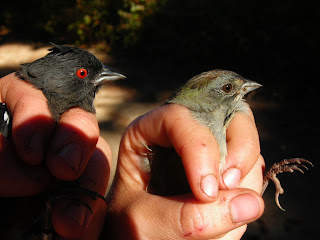
Spotted (adult) and Green-tailed (immature) Towhees; Aug 31, 2007. This is the 4th Green-tailed we've captured in 11 seasons - all since 2004. Note the difference in eye color.
(Apologies for the terrible photo quality, especially to John ;-) ... in the last week, we were excited to get a visit from Caroline and John ... our Lucky Peak MVPs over the last 2 seasons while I was away working at Camas NWR. They enjoyed some songbird banding (& the 2007 crew enjoyed working with them as well), some hawk trapping, and ....
That said, it's been a pretty exciting 10 days up on Lucky Peak as bird migration study is now occurring 24-7! Songbirds have been moderately busy but very diverse over the last 10 days (see season totals below).
The hawk migration count began Sat, Aug 25 and hawk trapping began the next day. The hawk count has been relatively slow so far but is starting to gain momentum; meanwhile, hawk trapping has been quite successful - especially considering that no big flights have occurred yet. The 2006 hawk flight was the lowest in the 12 years of standardized monitoring at Lucky Peak (a pattern also observed at most other count sites in the West last year but we don't really have a sense for what caused the dip in #s); thus, it will be interesting to see whether 2007 brings some recovery.
The owl study began on night of Tues, Aug 28 and a Flammulated Owl was captured in the 1st net run of the season (we hoped this would be a good omen) but we haven't caught another owl since. Owl banding is usually best after Sept 15 .... We did catch a Pallid Bat on the 29th and, knock on wood, we haven't captured a flying squirrel yet!
Now for the songbird #s. From July 16 through August 31, we captured 2,885 birds of 52 species. Since the year 2000 (when we standardized our start date at mid-July), this is the 2nd highest mid-season total - 2nd only to 2,893 birds captured by Aug 31 in 2006. Thus, we are only 8 birds off the record 2006 pace - most mid-season totals have been between 2,100 to 2,300 birds. A Green-tailed Towhee (our 4th in 11 years at Lucky Peak) was new for the season on 31 Aug and we caught our first 2 White-crowned Sparrows on 1 Sep.
I didn't bring all of the exact #s with me but the top ten species through Aug 31 were:
1) Dusky Flycatcher (312)
2) Yellow Warbler (278 - a single-season record)
3) MacGillivray's Warbler (~ 250)
4) Yellow-rumped Warbler (~230)
5) Western Tanager (190)
6) Spotted Towhee (~140)
7) Chipping Sparrow (~130)
8) Warbling Vireo (~120)
9) Nashville Warbler (~120)
10) Brewer's Sparrow (80 - a single-season record)
Though less impressive (it seems that this species is more common as a spring migrant in southern Idaho), we are also at a single-season record for Swainson's Thrushes (22; previous record was 20). Also, we are now starting to transition from Neotropical migrants to temperate migrants - juncos, kinglets, and WC Sparrows will all become more common in the next couple weeks while most longer-distance migrants will start to diminish in #s.
Now, a few pics:
Subscribe to:
Comments (Atom)
Mission: to contribute to the conservation of western migratory landbirds through cooperative research and public education
