IBO e-newsletter: December 2011
This is the first official IBO e-newsletter, and hopefully the first of many to come!! Since this e-newsletter is a new endeavor for us, any comments or suggestions you may have are most welcome.
jessicapollock@boisestate.eduHighlights in this issue:
New Office
2011 Projects: Lucky Peak, Golden Eagles, Long-billed Curlews
IBO's First Annual Raptor Workshop
2012 Projects Needing Volunteers
Are you able to donate to IBO?
New Office
As most of you know, we moved into a new office space in April. After such a busy 2011 field season, we are finally getting back into "office mode" and slowly unpacking and organizing. We have new banners outside our office to showcase and attract more attention to the Idaho Bird Observatory. Our new office is located at the corner of University Dr. and Captiol Blvd...near the Quiznos Subs. Although we are still unpacking, stop by and visit us!
2011 Project Summaries
2011 was a busy field season for IBO! Our field season started March 7th and lasted until October 31st. That's an almost 8-month field season (no wonder we haven't found time to unpack in our new office yet!)! Our 2011 field work included projects researching Golden Eagles, Long-billed Curlews, Flammulated Owls, songbird point counts across northern Idaho and the Craters of the Moon National Monument, and, of course, our Lucky Peak project!
Lucky Peak
2011 marked our 19th season on the Boise Ridge! The season was a huge success due to the generous support from our donors and volunteers....thank you! We couldn't have done it without YOU! We banded over 5,000 songbirds, over 1,000 raptors, and almost 600 owls! Over 1,000 people visited us and we hosted a record 45 organized groups from around the community including school and scout groups. What a great season! A big THANKS to our 2011 crew and core volunteers: Jethro Runco, Garrett MacDonald, Morgan Parks, Blanca Jimeno, Jenna Raino, Jessica Pollock, Heidi Ware, Dave and Carol Wike, Gary Robinson, Liz Urban, Lauren Whitenack, Kerstin Beerweiler, LeRoy Fink, Genevieve Rozhon, James Butch, Ryan Mong, Erin Strasser, Rob Miller, and Lauren Lapinel. A big thanks also to our fearless leader on the mountain Jay Carlisle and our commander-in-chief Greg Kaltenecker. Way to go team! Thanks also to the Boise Co-op and Blue Sky Bagels for their generous food donations to our crew and Ed Bottum and Krista Muller at the Idaho Department of Fish and Game for their support!

Golden Eagle Project
In conjunction with the Idaho Department of Fish and Game (IDFG) and the Bureau of Land Management (BLM), the IBO crew searched across much of southern Idaho for Golden Eagles and their nests. Our surveys took us to the South Hills, the Albion, Cotterell, and Deep Creek mountains, the Bennett Hills, and beyond! Until this project, Idaho lacked basic information on the distribution, population size and nesting locations of Golden Eagles outside of the Snake River Birds of Prey National Conservation Area. IDFG was interested in meeting these information needs by conducting an inventory of nesting golden eagles throughout southern Idaho. Moreover, the recent growth in renewable energy development (specifically wind turbines) in southern Idaho spurred this project since Golden Eagles are sometimes known to collide with wind turbines and/or are electrocuted by their distribution lines. The information IBO collected on this project will help land managers identify potential impact "hotspots" (i.e., near occupied nesting territories), and hopefully enable a proactive approach to evaluating potential impacts to Golden Eagles from energy development. Funding for this project came from the BLM Idaho State Office. The IBO crew located 99 Golden Eagle nests!!! Overall the project (in conjunction with IDFG and other partners) discovered or verified 168 distinct Golden Eagle territories and 384 unique nests across the entire state!!! A big thanks to the IBO Golden Eagle crew: LeRoy Fink, Genevieve Rozhon, Lindsey Keser, Dustin Maloney, Mark Pollock, Yozora Tadehara, and Jessica Pollock.

Long-billed Curlew Project
This was the third year of the Long-billed Curlew project, which is also being conducted in conjunction with IDFG. 2011 was not a good year for Long-billed Curlew numbers in our study area. Reproductive effort was very low compared to previous years. The crew found only 3 curlew nests (compared to 17 and 20 in the previous two years), and only 1 of the 3 nests was successful. Thanks to the 2011 crew members and volunteers: Morgan Parks, Alex Lamoreaux, Anna Fasoli, Heather Craig, Shaun Olson, Eddie Shea, Lauren Whitenack, Dave Wike, Alessia Cantaboni, Cheryl Huizinga, Patty McGrath, and Sandy Vistine-Amdor for all their hard work!!Long-billed Curlews are declining throughout their range and we don't know exactly why. Contributing factors may include habitat loss and degradation and/or human disturbances. Some threats may be during migration and/or on their wintering grounds. But the problem is that we don't even know where the curlews that breed in Idaho go in the winter! Our knowledge about what curlews do once they leave Idaho is extremely poor, hampering our ability to explain population declines. Basic questions about which we lack information include:
What migratory routes do curlews take to reach their wintering grounds?
When do Idaho curlews arrive on their wintering grounds, and where do they winter?
What habitats do curlews require during migration? What about in winter?
What threats are they facing on their travels between Idaho and their southerly wintering grounds?
The Long-billed Curlew is a Species of Greatest Conservation Need in Idaho, and is also a species of concern with the BLM, the US Fish and Wildlife Service, and Environment Canada. Satellite transmitters can provide valuable insights into the species' migratory routes, timings, and habitat requirements across Canada, the US, and Mexico. This information will help researchers in their efforts to conserve curlews!!
 Photo: Alex Lamoreaux
Did you know?....A satellite transmitter study in Montana documented a Long-billed Curlew traveling nearly 1,250 miles in just 27 hours!!! Wow!!!
Would you be willing to sponsor a satellite transmitter and create a unique opportunity to follow the migration of your very own curlew?
Adopt a Long-billed Curlew!!!
Along with weekly blog and/or email updates about your curlew's migration progress, donors will receive a portrait of their curlew and will be recognized in our annual newsletter. In addition, full sponsors will receive a footprint cast of their bird and the opportunity to name their curlew. All donations are tax deductible. We are a non-profit, 501 (c) (3) organization. You can also support education in Idaho by requesting your donation go toward a "classroom bird" in a local school! Your donation will allow schools to name and track their own curlew in the classroom each week, while learning about ecosystem interactions, conservation, geography, migration and curlew natural history!! To sponsor a Long-billed Curlew for you or as a gift for someone else (or if you have any questions) please get in touch with Dr. Jay Carlisle at the Idaho Bird Observatory:
jaycarlisle@boisestate.edu or call us at 208-426-5203.
IBO's First Raptor Identification Workshop a Success!
We hosted our first raptor ID workshop from September 23-25 and had local folks attending plus many from across the country. The workshop was a successful fundraiser for IBO and participants had a great time learning about raptors in the classroom and viewing them on migration at Lucky Peak. We are planning another raptor ID workshop for next year, and hope to provide other bird-related workshops throughout the year in the future. Do you have any ideas? Potential future workshops may include one on banding, songbird ID, etc. If you have a desire to learn something specific, will you let us know? Email
jessicapollock@boisestate.edu with any workshop ideas you may have.

2012 Field Projects Needing Volunteer Support
We can always use support from volunteers eager to get some "hands-on" field experience working with birds. We have a few projects where volunteers or aspiring biologists can help us out.
- Our Long-billed Curlew project will be from mid-March - June. Anyone interested in learning how to nest search for these elusive birds is welcome to join us! The field area is northwest of Caldwell, and is an easy day trip. Email jessicapollock@boisestate.edu if you are interested.
- Our hummingbird banding project is starting up again next year, likely from June-August. We are hoping to have a site in Idaho City where there are breeding Calliope Hummingbirds. Volunteers are always needed, so if you are interested in learning how to capture hummingbirds, handle them correctly, and record important information, let us know! jessicapollock@boisestate.edu
- There is potential for volunteer support for a White-faced Ibis project in eastern Idaho from mid-April to early July 2012. If you live in eastern Idaho and can donate some time to surveying for this species contact jaycarlisle@boisestate.edu
- Monitoring Avian Productivity and Survivorship (MAPS) songbird banding at Lucky Peak in June and July. Contact jaycarlisle@boisestate.edu
Are you able to Donate to the Idaho Bird Observatory?
We rely on your support - please make a tax-deductible year-end gift today. For those that don't know, the Idaho Bird Observatory is funded almost completely through grants, contracts and largely by donations from individuals like YOU!! There are two areas for which we are currently seeking funding:
Annual Fall Migration ProjectWe always need to secure funding for our annual fall migration project, which will continue into its 20th year next fall. Since Lucky Peak is at the core of what we do as the IBO, it's hard to imagine not being able to continue this project. We operate the Lucky Peak project efficiently and cheaply using volunteer labor and in-kind donations, but there are still some hard costs associated with this effort. We require close to $30,000 each year to maintain our standardized monitoring of songbirds, raptors, and owls during their autumn migration, and to conduct our ever-popular public education work. This funding supports a dozen full-time interns and buys necessary equipment and supplies. Please email
gregorykaltenecker@boisestate.edu if you have any questions about donating to this project. Please specify "Fall Migration" in the memo line of your check to ensure donations are routed to the correct project.

Hummingbird ProjectIn 2011 we banded hummingbirds along the Boise River at the Idaho Shakespeare Festival property. Although hummingbird numbers were lower than expected, we had almost 200 visitors, many of which got to see hummingbirds up close and in the hand! We had many children that learned all about hummingbirds and helped us release the birds. Our goal in 2012 is to establish a hummingbird monitoring site at a higher elevation near Idaho City. We already have the site selected and know that there are many hummingbirds there, including breeding Calliope Hummingbirds, a target species of this project. We are hoping to raise close to $5,000 to run this project in 2012. This money will support a full-time biologist and will pay for necessary fuel and banding supplies. Please email
jessicapollock@boisestate.edu if you have any questions about donating to this project. Please specify "Hummingbirds" in the memo line of your check to ensure donations are routed to the correct project.

The Idaho Bird Observatory is an academic research program of Boise State University, and accepts donations through its 501 (c)(3) sponsor, the Boise State University Foundation, Inc. Idaho Residents who make a donation to a state educational entity receive a 50% tax credit on that donation, and donations to the Idaho Bird Observatory qualify for this tax credit. To donate, please make checks payable to the Idaho Bird Observatory (please specify in the memo line of your check which project you are donating towards), and mail to:
Idaho Bird Observatory c/o BSU Foundation, Inc.
1910 University Dr.
Boise, ID
83706-9987
Or you can donate online through Boise State University at the link below:https://giving.universityadvancement.org/
Select "Other" as the designation and specify "Idaho Bird Observatory" in the Special Designation. Please also specify which project you are donating towards (e.g., Annual Fall Migration or Hummingbirds)
Any support you can provide will be greatly appreciated!! Your donations are tax deductible and you will receive a receipt for tax purposes.
Happy Holidays from the Idaho Bird Observatory!!!!!



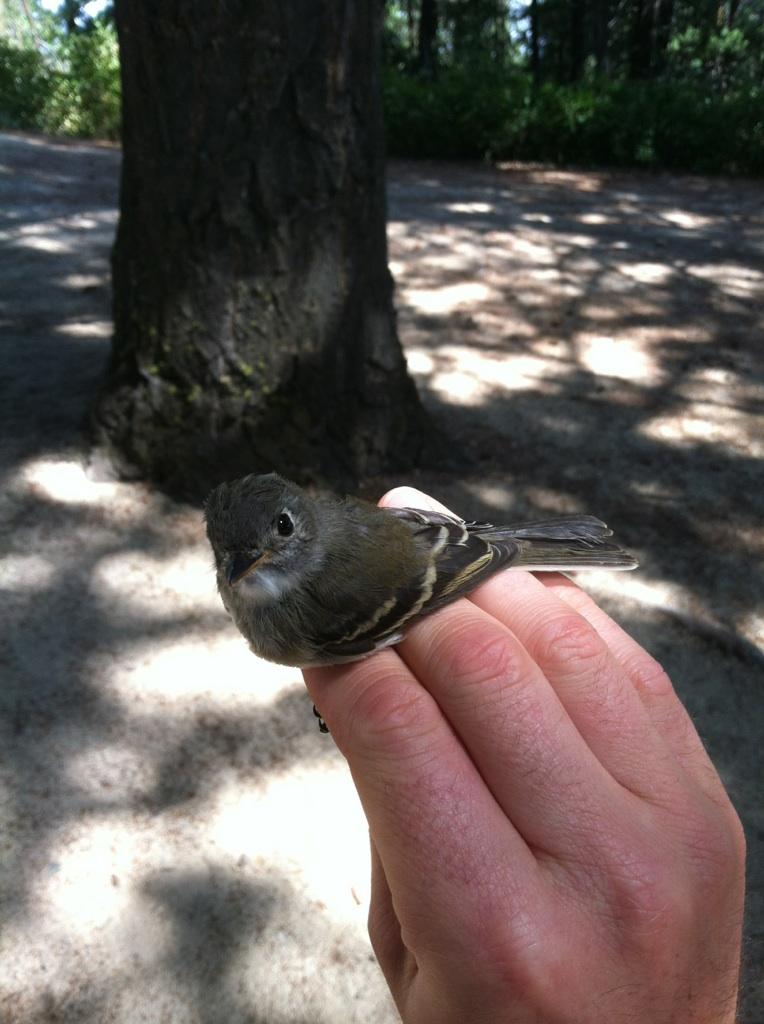


 Fox Sparrow
 Black-headed Grosbeak Family (one adult, three young)
 young Ruby-crowned and Golden-crowned Kinglets
 Wilson's Warbler
 Red-breasted Nuthatch
 White-crowned and Golden-crowned Sparrows
 Least Flycatcher
 Calliope Hummingbird wrapped up for safety while banding
 Townsend's Warbler



